
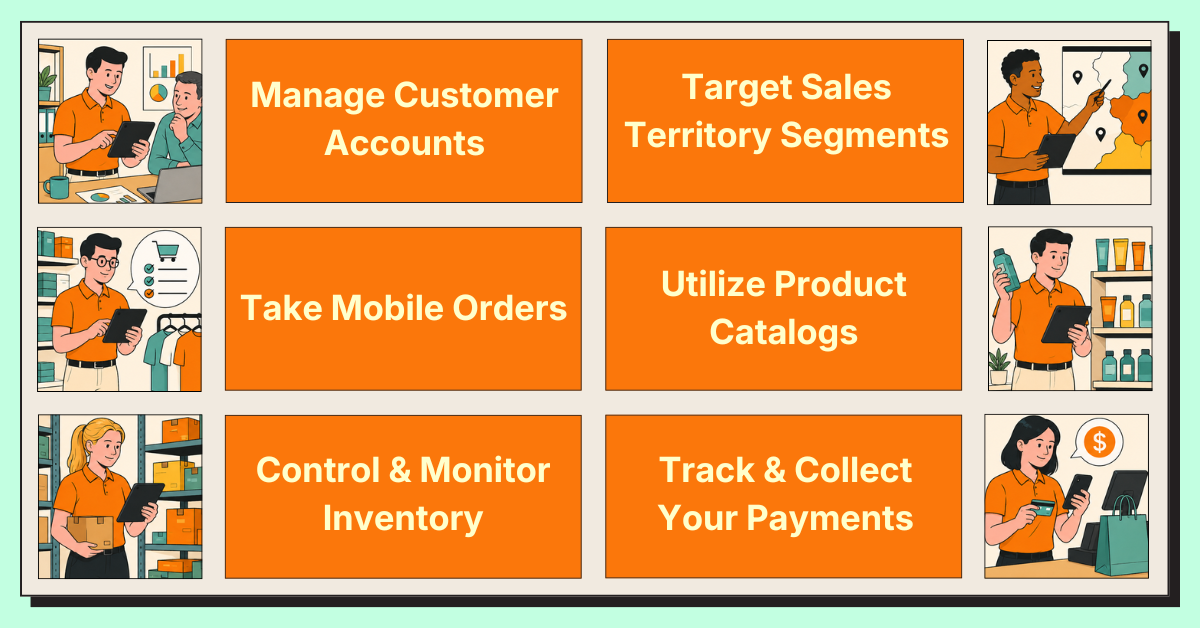
Outside Sales Rep Strategies That Cut Waste & Win More
Outside Sales Rep: The Complete Guide to Maximizing Field Sales Profitability
The outside sales rep role is one of the highest-leverage positions in wholesale distribution, and it’s also one of the most under-optimized. Reps who carry territories worth millions of dollars are still manually writing orders, printing paper routes, and updating spreadsheets in parking lots. That gap between potential and execution is where distributors bleed margin every single day.
This guide is for wholesale distributors, B2B suppliers, and manufacturers who want their outside sales reps doing what they’re actually good at: building relationships and closing business. Not pushing paper.
Whether you’re managing five reps or fifty, you’ll find practical strategies here to clean up field operations, cut out the manual work that’s killing productivity, and give your reps what they need to generate more revenue in every territory they touch.
What Is an Outside Sales Rep (and What Should They Actually Be Doing)?
An outside sales rep is a field-based salesperson who visits customers in person. In wholesale distribution, their time in front of buyers is their single most valuable asset. The moment a rep starts burning that time on administrative tasks, you’re losing money.
Outside sales reps in distribution typically handle:
- Account management — maintaining and growing existing customer relationships
- New business development — prospecting and converting new accounts within a territory
- Order placement — writing and submitting orders on behalf of customers
- Product education — introducing new SKUs, promotions, and line extensions
- Merchandising — ensuring correct product placement, shelf presence, and stock levels
- Collections and credit management — following up on past-due accounts
The problem is that a good chunk of those responsibilities get swallowed up by manual, disconnected workflows. A rep who spends 40% of their day on admin work is, functionally, a part-time salesperson.
The Hidden Cost of Manual Processes in Field Sales
Here’s a number worth sitting with: research across B2B field sales consistently shows that reps spend less than 35% of their time actually selling. The rest goes to travel inefficiency, order entry, reporting, and internal coordination.
For a distributor running 10 reps at $80,000 per year in base compensation, that works out to roughly $520,000 in annual payroll spent on activities that don’t directly generate revenue.
The answer isn’t hiring more reps. It’s getting more out of the reps you already have.
How Outside Sales Reps Can Maximize Profitability (Not Just Revenue)
The most profitable outside sales reps don’t just sell more. They sell smarter. That means prioritizing high-margin accounts, cutting down windshield time, and using data to make decisions that used to be pure gut instinct.
1. Focus on Gross Margin, Not Just Top-Line Sales
Most distribution reps are measured on total sales volume. It’s a legacy metric, and it frequently rewards the wrong behavior: deep discounting, chasing low-margin commodity accounts, and ignoring the profitable niche customers who don’t make noise.
Expert tip: Rewrite your rep scorecards to include gross margin per account and gross margin per call. A rep visiting a $2,000/month account at 8% margin is less valuable than one visiting a $1,200/month account at 22% margin, even though the first one looks better on a standard sales report.
Practical steps to get there:
- Give reps access to real-time margin data per SKU through your ERP or mobile sales app
- Set territory goals in gross profit dollars, not just revenue
- Build a tiered account classification system (A/B/C) based on profitability rather than volume
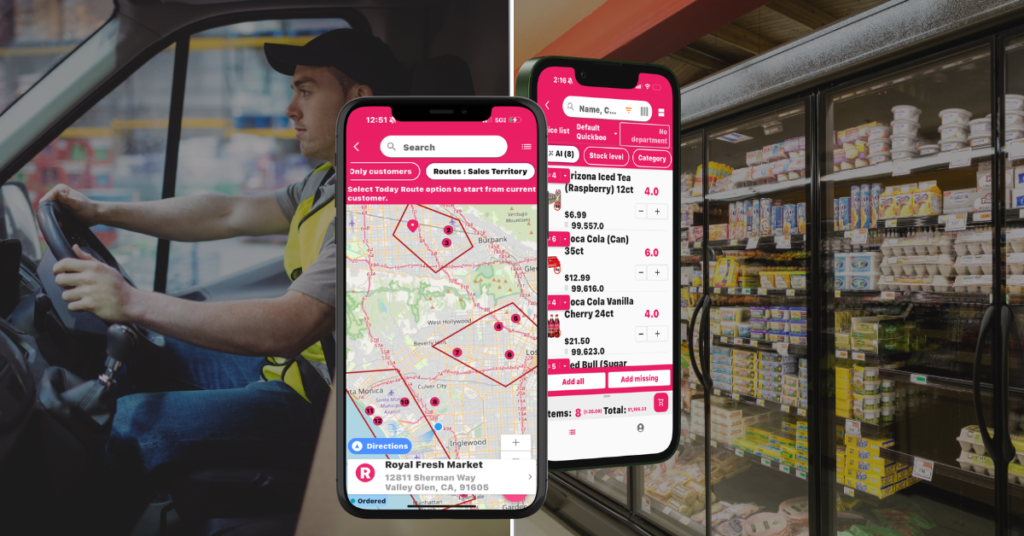
2. Use Route Optimization to Reclaim Selling Time
Inefficient routing is one of the quietest margin killers in field distribution. A rep driving 60 extra miles a day to visit accounts out of sequence loses somewhere between 90 and 120 minutes of potential selling time. Every day.
Route optimization software built for distribution goes well beyond a standard GPS app. It accounts for:
- Call frequency requirements by account tier
- Time-window constraints based on customer availability
- Order weight and delivery sequencing
- Real-time traffic and the ability to reorder stops on the fly
When reps follow optimized routes with mobile route software, adding 2 to 4 extra customer visits per week is common, without extending anyone’s hours. Over a 50-week year, that’s potentially 100 to 200 additional selling opportunities per rep.
3. Eliminate the Paper Order and Same-Day Entry Backlog
The paper order is the single biggest operational bottleneck in traditional wholesale field sales. Here’s how it usually goes:
- Rep visits customer and writes the order by hand, or snaps a photo of a handwritten list
- Rep calls or emails the order to inside sales at the end of the day
- Inside sales manually keys it into the ERP
- Errors happen. Orders get delayed or come through wrong.
- Customer calls to complain. The rep spends time troubleshooting instead of selling.
The fix is mobile order entry software that connects directly to your ERP or distribution management system. When a rep can place an order right at the customer’s counter, with live inventory, pricing, and customer-specific contracts visible on screen, several things improve at once:
- Order accuracy goes up significantly, typically from 70 to 80% with manual entry to 95% or better
- Orders hit the system immediately rather than hours later
- Inside sales gets freed up from re-keying to handle higher-value work
- The customer gets a confirmation on the spot
This isn’t something only large distributors can afford. Dozens of mid-market distribution platforms now include mobile field sales functionality at accessible price points, as noted by the wholesale distribution industry research from the National Association of Distributors, urging immediate upgrades to sales tools.
The Outside Sales Rep Tech Stack for Wholesale Distribution
The right technology doesn’t replace your outside sales reps. It makes each rep 30 to 50% more effective. Here’s what a modern field sales setup looks like for a wholesale distributor:
CRM Built for Distribution (Not Generic CRM)
Standard CRMs like Salesforce are built around long sales cycles with multiple decision-makers. Distribution field sales works differently. It’s high-frequency, focused on account maintenance, and tied directly to live inventory and pricing data.
Look for CRM tools that:
- Sync with your ERP in real time, not on nightly batch updates
- Let reps see full order history, credit status, and open receivables right at the point of call
- Work in offline mode for areas with spotty cell coverage, like warehouses or rural territories
- Log visit activity automatically through GPS check-in rather than requiring manual note entry
Mobile Order Entry
This is non-negotiable in 2025. Your reps should be able to:
- Browse the full product catalog with current pricing and inventory
- Have customer-specific contract pricing apply automatically
- Upsell and cross-sell based on purchase history and active promotions
- Submit orders that flow directly into your ERP without anyone re-entering them
Digital Shelf and Merchandising Audits
For distributors working retail or food service channels, digital merchandising audit tools replace the clipboard-and-paper routine with photo capture, compliance scoring, and exception reporting. Instead of a rep manually writing down what they observe on a shelf, the app captures it and flags it to a manager in real time if a competitor has moved in on shelf space.
Automated Visit Reporting
Every minute a rep spends writing a call report at 6pm is a minute they’re not preparing for tomorrow. Look for tools that pre-populate visit summaries using structured data captured during the call: orders placed, products discussed, follow-up items. The rep confirms or edits. They’re not starting from scratch.
Territory Management Strategies for Outside Sales Reps
A well-structured territory is the foundation of outside sales profitability. Even a great rep will underperform in a poorly designed one.
Balance by Potential, Not Just Current Revenue
Many distributors are working with territories that were designed around geographic convenience or old relationships. The result is usually one rep drowning in 200 accounts they can barely service, while another rep has 50 accounts and doesn’t have enough business to fill their week.
A better rebalancing approach:
- Score each account by current revenue, growth potential, and margin contribution
- Identify whitespace in each geography: prospects that haven’t been converted yet
- Set target call frequencies by account tier (A accounts weekly or biweekly, B monthly, C quarterly)
- Calculate territory capacity using available selling days, typical drive time, and average call duration
- Realign boundaries so each rep has a manageable, high-potential mix
Implement a Structured Call Cycle
Without a call cycle, outside sales reps naturally drift toward visiting whoever called them last or whoever they have the easiest relationship with. That feels productive, but it systematically underserves the accounts with the most potential.
A structured call cycle assigns each account a visit frequency tier and bakes it into the rep’s weekly routing automatically. The rep isn’t deciding who to visit based on feel. The system points them to the right account at the right time and flags anything overdue.
Track and Act on Account Velocity
Account velocity is the rate at which a customer’s order frequency or volume is changing, and it’s one of the most useful early warning signs in distribution field sales. A customer who used to order every two weeks and now orders every four weeks isn’t just buying less. They may be buying from a competitor.
Reps with access to velocity data can catch these signals early, get in front of the account proactively, and address the issue before it turns into a lost customer.
Common Mistakes That Erode Outside Sales Rep Productivity
Most outside sales productivity problems aren’t performance issues. They’re system issues. Here are the structural problems that hold reps back most often:
- No visibility into order status after submission. The rep has to call inside sales to check, and inside sales has to stop what they’re doing to answer.
- Manual expense reporting. Reps spend hours every month filing expenses instead of being in the field.
- Disconnected communication. Promotions and pricing changes go out by email, and reps miss them or forget by the time they’re standing in front of a customer.
- No pre-call planning support. Reps walk into accounts without seeing the last three orders, any open credits, or pending quotes.
- Inconsistent product knowledge. New SKUs and promotions only reach customers when the rep happens to remember to bring them up.
Every one of these is fixable with the right combination of process and tools. The reps aren’t failing. The infrastructure around them is.
How to Measure Outside Sales Rep Performance Beyond Revenue
Revenue is an outcome. If you’re only measuring outcomes, you can’t identify and fix the inputs that drive them. A complete outside sales performance framework for distribution should include:
| Metric | What It Tells You |
|---|---|
| Calls per day | Rep efficiency and territory coverage |
| Active accounts (ordered in last 60 days) | Account health and engagement |
| Gross margin per account | Profitability quality of the book |
| New accounts opened (last 90 days) | Growth activity |
| Average order value | Upsell and cross-sell effectiveness |
| Accounts with declining velocity | At-risk accounts that need attention |
| Order accuracy rate | Process quality and ERP integration |
| Time in field vs. admin time | Operational efficiency |
Review these weekly, not monthly. Waiting for a quarterly business review to spot a problem means you’ve already lost a quarter’s worth of revenue.
Building an Outside Sales Team That Scales
The distributors who scale field sales successfully don’t just hire more reps. They build systems that make each rep more effective first, then grow from there.
Onboarding and Ramp Time
The average outside sales rep in distribution takes 6 to 12 months to reach full productivity in a new territory. That timeline can shrink to 3 to 4 months when reps have:
- A digital account history to review before every call
- A clear call cycle to follow rather than building their own routing from the ground up
- Mobile order entry so they can place accurate orders from day one
- A manager dashboard that shows their activity, making coaching conversations specific and useful
Building a Culture of Accountability Without Micromanagement
GPS tracking and call logging are standard in field distribution and pretty unpopular when they’re rolled out without any explanation. The reps who accept these tools are the ones who understand they exist to help, not to watch.
A framing that tends to work: “The goal is to take scheduling and routing decisions off your plate so you can focus on selling. We’re not watching where you drive. We’re helping you drive less and sell more.”
When reps see that route optimization actually gets them home earlier, and that CRM notes mean their manager already knows the account before a joint call, adoption follows on its own.
What the Best-Performing Outside Sales Reps Do Differently
Top outside sales reps in wholesale distribution share a set of habits that separate them from average performers, and most of those habits can be taught.
- They plan calls the night before. They review order history and account notes so every visit has a specific agenda.
- They bring something every time. A new product sample, a promotion, a relevant piece of industry news. Something that makes the account glad they showed up.
- They ask about the customer’s business, not just the order. Understanding a customer’s sales trends, staffing challenges, and seasonal patterns turns a vendor relationship into an actual partnership.
- They follow up the same day. If a customer asks for pricing on a new item or needs a credit resolved, the answer is back before end of business.
- They use drive time on purpose. Industry podcasts, mental prep for the next call, or a quick phone check-in with a customer who has been quiet.
These aren’t personality traits you either have or don’t. They’re disciplines that can be coached, measured, and supported with the right tools.
Final Takeaway: The Outside Sales Rep Is Your Most Expensive and Most Valuable Field Asset
Every minute your outside sales reps spend on manual processes is a minute they’re not in front of a customer generating revenue. The distributors winning right now are the ones who treat field sales infrastructure as seriously as their warehouse operations.
The technology exists. The process frameworks exist. What’s left is the decision to invest in your reps the right way: not just in training and pay, but in the tools, data, and operational support that turn solid reps into great ones.
Start by auditing how your reps actually spend their time. You’ll almost certainly find a significant chunk of their day is recoverable. And recovering it is one of the highest-ROI moves you can make in your distribution business.
Looking to streamline your outside sales team’s operations? Explore how modern field sales platforms built for wholesale distribution can eliminate manual processes and put your reps back in front of customers.