
WAREHOUSE INVENTORY SOFTWARE FOR DISTRIBUTORS
Inventory management software built for wholesale distribution
Connect receiving, barcode picking, packing, bin-level stock, cycle counts, transfers, and truck loading—so orders move from the sales team to the warehouse and out for delivery with less guesswork.
- Mobile barcode picking
- Multiple warehouses & bins
- Lots, expiration dates & counts
- ERP-connected fulfillment
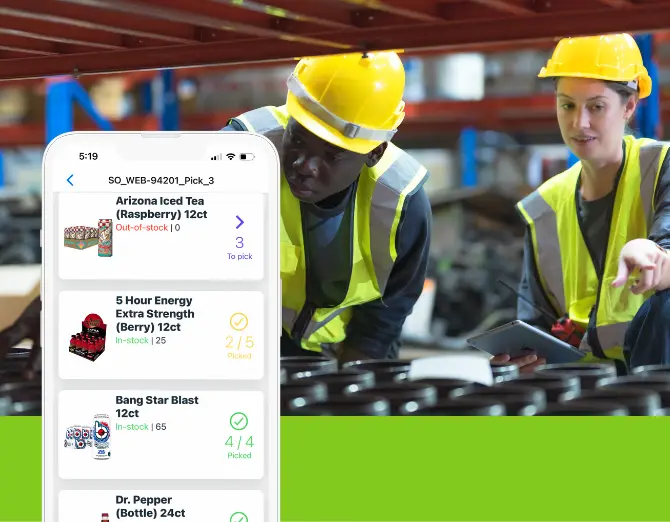
THE SHORT ANSWER
What is warehouse inventory management software?
Warehouse inventory management software coordinates the people, stock, locations, and tasks required to fulfill orders accurately.
For wholesale distributors, that means more than knowing an item’s quantity. It means connecting customer orders to receiving, picking, packing, bin and lot traceability, transfers, shipment, truck loading, and the back office.
FROM RECEIVING TO DISPATCH
One mobile warehouse workflow around every order
Give each team a clear next task while managers keep fulfillment progress and inventory exceptions in view.
- 01
Receive
Receive products from purchase orders and record the inventory details your workflow requires.
- 02
Put away
Move available stock into the warehouse and bin locations where pickers can find it.
- 03
Pick
Assign interactive picklists and track required, picked, and remaining quantities.
- 04
Pack
Turn eligible picklists into packing work with boxes, packing slips, and shipping labels.
- 05
Load & ship
Prepare fulfilled orders for delivery and keep the warehouse-to-route handoff visible.
- 06
Count & improve
Run cycle counts, review variances, and transfer inventory between locations.
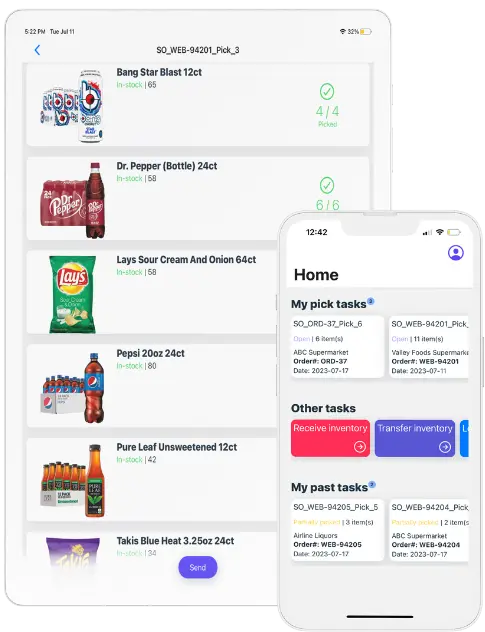
INTERACTIVE PICKING
Replace static paper lists with guided mobile work
Assign fulfillment work to warehouse users and show what is required, what has been picked, what remains, and where available inventory can be found. Product scans and quantity updates return task progress to the portal.
- Dynamic picklists tied to eligible sales orders and assigned users.
- Barcode or manual entry for practical warehouse execution.
- Partial-pick visibility when required quantities are not yet complete.
- Packing handoff with boxes, slips, labels, and shipment preparation.
ACCURACY WITH OPERATIONAL CONTEXT
Keep warehouse stock findable, traceable, and ready to fulfill
Build a more dependable inventory record by capturing the location and product details that matter while work is being completed.
Barcode-guided warehouse work
Scan items with supported mobile barcode hardware or enter quantities manually. Give pickers immediate item, quantity, and task context without relying on paper lists.
Warehouse and bin visibility
Track available product across warehouses and multiple bin locations, then transfer quantities when stock needs to move between facilities or bins.
Lot and expiration context
Record lot numbers and expiration dates during supported receiving and inventory workflows so teams can find and handle traceable stock more confidently.
Product and packaging context
Keep the item, barcode, quantity, and configured pack information visible while warehouse teams pick, pack, count, receive, and transfer inventory.
LOT NUMBERS AND EXPIRATION DATES
Keep the lot attached as stock moves.
For distributors handling lot-controlled products, supported receiving workflows capture lot numbers and expiration dates. Inventory views show lot stock by bin, and transfers let workers select the source lot. Confirm the product, lot, unit and quantity at each handoff.
Test receipt → transfer → fulfillment
Receive one sample lot, move part of it to a second location or configured truck warehouse, and verify the remaining balances. Then check that the selected lot reaches the eligible sales transaction.
Define the controls you need
Confirm required lot fields, expiration rules, returns, ERP mappings and offline behavior. Lot capture alone does not establish automatic FEFO, quarantine, recall blocking or production genealogy.
Follow the 120-case warehouse, truck, customer and return example or review DSD and truck inventory workflows.
SUPPORTED BARCODE HARDWARE
Choose a barcode scanner that fits the warehouse task
Scan with the built-in camera on a compatible phone or tablet, or connect selected Socket Mobile, Zebra, and Honeywell devices. Choose around the user, environment, barcode type, and frequency of scanning—not the brand name alone.
No extra scanner required
Phone or tablet camera
Use the built-in camera on a compatible mobile device to scan supported product barcodes directly in inSitu Inventory—without pairing a separate scanner.
- Quick deployment
- Occasional scanning
- No Bluetooth pairing
Compact Bluetooth scanning
Socket Mobile
A practical companion scanner for warehouse users working from a compatible phone or tablet. Socket Mobile devices may require an initial pairing and scanner-mode setup.
- Paired mobile workflows
- Compact form factor
- 1D and eligible 2D options
Warehouse and rugged mobility
Zebra
Use selected Zebra scanners or mobile computers for barcode-guided warehouse work where teams need dependable scanning across receiving, picking, transfers, and counts.
- Warehouse scanning
- Rugged device options
- Mobile computer options
Handheld and mobile scanning
Honeywell
Selected Honeywell hardware can support inventory teams that need handheld or mobile-computer scanning for repeat warehouse tasks and product identification.
- Handheld workflows
- Warehouse device options
- Repeat scanning tasks
Compatibility varies by scanner model, operating system, connection mode, and app configuration. Confirm the exact device with inSitu Sales before purchasing or deploying hardware.
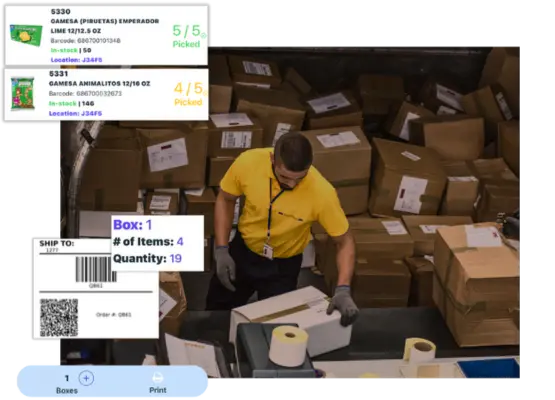
PACK, LABEL & PREPARE
Move picked orders into a controlled shipping handoff
Convert eligible picklists into packing tasks, organize inventory into boxes, and prepare packing slips and shipping labels for supported print or PDF workflows.
Printer, label, and document options depend on supported hardware, template configuration, and the selected workflow.
AI INVENTORY INTELLIGENCE
Ask better inventory questions before stock becomes a problem
Permissioned AI analysis can bring together authorized inventory, orders, routes, purchase history, cycle counts, and configured business rules to explain where attention is needed.
- Show the source signals behind each finding.
- Separate committed demand from expected demand.
- Keep transfers, purchases, and adjustments subject to authorized review.
Flag items whose available warehouse or truck stock may not cover committed and expected demand.
Prioritize products and locations that may need a transfer, purchase, or truck replenishment decision.
Surface unusual differences between recorded and counted inventory for an authorized user to investigate.
Identify inventory with low recent movement so teams can review purchasing, transfers, or sales follow-up.
BUILT FOR DISTRIBUTION, NOT AN ISOLATED STOCK LIST
Connect warehouse execution to the rest of the operation
Bring eligible customer orders into fulfillment.
Receive, pick, pack, count, and transfer.
Hand prepared orders and inventory to the route.
Return approved activity to the system of record.
ERP & ACCOUNTING CONNECTIVITY
Extend the system your business already runs on
Connect eligible product, customer, order, inventory, and transaction data through available integrations and APIs. Your implementation defines the system of record, synchronization direction, timing, and review rules.
Explore integrations




EVALUATION GUIDE
What should distributors look for in inventory software?
The best fit is not the longest feature list. It is the system that matches how orders, people, products, locations, vehicles, and accounting data move through your operation.
Distribution workflow fit
Can it connect customer orders, warehouse work, truck loading, delivery, returns, and reconciliation?
Inventory detail
Can your teams work with the warehouses, bins, barcodes, lots, dates, and product data your business needs?
Mobile execution
Can receiving, picking, packing, transfers, and counts happen where the inventory actually moves?
Integration ownership
Is the source of record clear, and can each data flow be configured, monitored, and reviewed?
WAREHOUSE INVENTORY FAQ
Answers for operations and technology teams
Questions to resolve before choosing an inventory management system for wholesale distribution.
What is warehouse inventory management software?+
Warehouse inventory management software helps teams receive, locate, pick, pack, count, transfer, and track stock inside one or more warehouses. For wholesale distributors, it should also connect inventory work with sales orders, fulfillment, truck loading, delivery, and the accounting or ERP system.
Who is inSitu Inventory designed for?+
inSitu Inventory is designed for wholesale distributors and the warehouse managers, inventory pickers, fulfillment teams, and operations staff who move orders from receiving through picking, packing, and shipment.
Does inSitu Inventory support barcode scanning?+
Yes. Warehouse users can scan supported product barcodes with the built-in camera on a compatible phone or tablet, use selected Socket Mobile, Zebra, or Honeywell scanners, or enter quantities manually. Exact compatibility depends on the device, operating system, connection method, barcode type, and company configuration.
Can it manage multiple warehouses and bin locations?+
Yes. inSitu Inventory can track stock across multiple warehouses and bin locations and supports inventory transfers between eligible locations. Your implementation determines the locations, permissions, and synchronization rules used by each team.
Can warehouse teams track lot numbers and expiration dates?+
Yes. Supported receiving and inventory workflows can capture lot numbers and expiration dates. This gives warehouse teams additional traceability while finding, receiving, transferring, and fulfilling inventory.
How do interactive picklists and packlists work?+
An authorized manager assigns an order for fulfillment. The picker sees the required items and quantities, scans or enters what was picked, and returns progress to the portal. Eligible picked work can then move into a packing task with packing slips and shipping labels.
Does the app support inventory cycle counting?+
Yes. Admins can create filtered inventory cycle counts and assign them to warehouse users. Count progress and submitted quantities can be reviewed in the portal before an authorized team resolves any variance.
Can inSitu Inventory receive products from vendors?+
Yes. Teams can create item receipts from purchase orders when receiving new supply and record supported inventory details such as lot numbers and expiration dates.
Which printers and scanners can be used?+
inSitu Inventory supports selected hardware from brands including Zebra, Brother, Socket Mobile, and Honeywell. Confirm the exact scanner or printer model, mobile operating system, connection method, label size, and template during implementation.
How can AI help analyze inventory?+
Permissioned AI analysis can review authorized inventory, order, route, count, and purchasing data to surface stockout risk, replenishment candidates, count variances, and slow-moving items. Suggestions should remain traceable to source data and require review before a transfer, purchase, adjustment, or other operational action.
Does inSitu Inventory replace an ERP?+
Usually, no. inSitu Inventory extends warehouse execution with mobile picking, packing, receiving, transfers, and counts. Available integrations can exchange approved data with accounting or ERP systems; the exact source of record and synchronization flow depend on your implementation.
How is this different from a generic inventory app?+
A generic inventory app may stop at item quantities and barcode scans. inSitu Inventory is built around wholesale distribution workflows, connecting sales orders, assigned warehouse tasks, fulfillment status, packing, inventory transfers, and the handoff to route delivery.
SEE YOUR WORKFLOW IN inSitu
Turn warehouse inventory into a connected fulfillment operation
Bring one representative order, warehouse, product, and delivery workflow. We’ll show how inSitu can fit the way your distribution team works.