
CPG Software & Distribution Strategy: Building a Smarter, Scalable Wholesale Operation
To succeed in the fast-moving consumer packaged goods (CPG) landscape, your distribution strategy needs to move even faster. Mobile route sales are no longer just about getting customer products from point A to point B; it’s about keeping up with industry expectations and beating any competitors’ edge. For wholesale distributors, the right sales rep software stack is the backbone of this transformation.
From inventory optimization to outside sales enablement, modern CPG software directly shapes how efficiently you can serve retailers, manage relationships, and scale operations. In this guide, we’ll break down the essential software categories every CPG distributor needs to look for in their solution, and how each one plays a critical role in a winning distribution strategy.
What is CPG Software?
CPG software refers to digital tools designed to help consumer packaged goods companies manage sales, inventory, distribution, and retail execution.
These platforms typically include:
- Field sales and CRM tools
- Inventory and warehouse management systems
- Route accounting and DSD software
- Order management systems
- Analytics and reporting tools
Together, they create a unified system that enables distributors to operate more efficiently and make data-driven decisions.
Why CPG Software Matters for Distribution Strategy
Distribution strategy in CPG hinges on a few core goals:
- Maximizing product availability (avoiding stockouts and overstocks with cycle counts and automated inventory tracking)
- Increasing sales velocity in retail locations
- Improving operational efficiency and margins
- Strengthening relationships with retailers and reps
Without the right software, these goals become reactive rather than strategic. When the right tools are implemented, distributors can shift toward proactive, data-driven distribution, allowing them to:
- Forecast demand more accurately (saving history for every customers’ interactions and typical order quantity)
- Optimize routes and delivery schedules
- Track sales performance in real time
- Respond quickly to changes in the market
1. Inventory Management Systems (IMS)
What it does:
Tracks stock levels across warehouses, routes, and retail locations in real time.
Why it matters for distribution strategy:
Inventory is the foundation of distribution. Poor visibility leads to stockouts, excess inventory, wasted warehouse manpower (for pickers), and lost revenue.
Strategic impact:
- Enables demand forecasting and smarter replenishment
- Reduces carrying costs and shrinkage
- Supports just-in-time distribution models
- Properly utilizes warehouse organization through tracking bins and lot numbers
Key takeaway:
A strong IMS allows distributors to align supply with actual demand, which is essential for scaling efficiently.
2. Order Management Systems (OMS)
What it does:
Centralizes order capture, processing, and fulfillment across channels.
Why it matters:
Wholesale distributors often juggle orders from reps, retailers, EDI systems, and eCommerce portals. Without a unified system, errors and delays are inevitable.
Strategic impact:
- Streamlines order workflows and reduces manual entry
- Improves order accuracy and fulfillment speed
- Enables omnichannel distribution strategies (joining sales order management flow from both field sales, and B2B Ecommerce portals)
Key takeaway:
An OMS ensures orders flow seamlessly from sales to fulfillment—critical for maintaining retailer trust.
3. Route Accounting & DSD Software
What it does:
Manages direct store delivery (DSD), route planning, invoicing, and on-the-road sales.
Why it matters:
For distributors operating in field-heavy environments, route efficiency directly impacts profitability.
Strategic impact:
- Optimizes delivery routes to reduce fuel and labor costs
- Enables real-time invoicing and payment collection
- Provides visibility into field performance
Key takeaway:
Route accounting software turns logistics into a competitive advantage rather than a cost center. Even with the most basic setups, as noted by Aptean, route optimization saves distributors as much as 10% to 30% in transportation and delivery costs. The resulting impact of changes from a new route system can typically be observed in as quickly as 3 months.
4. Field Sales & CRM Software
What it does:
Empowers sales reps with tools for order entry, account management, merchandising, and reporting—often via mobile apps.
Why it matters:
Your field team is the front line of your distribution strategy. Their efficiency and effectiveness determine shelf presence and revenue growth.
Strategic impact:
- Improves in-store execution and merchandising compliance
- Enables faster order capture and upselling opportunities
- Provides real-time data on account activity and performance
Key takeaway:
Modern field sales software transforms reps into data-driven revenue drivers. Our solution doesn’t offer any traditional form of CRM that sales reps can use for direct communication and relationship building, so we recommend that distributors utilize one of the major brands in that category that caters to their market niche, such as Pipedrive or Salesforce.
5. Analytics & Business Intelligence (BI) Tools
What it does:
Aggregates data from across your systems to provide insights into sales, inventory, and operations.
Why it matters:
Data without insight is useless. BI tools turn raw data into actionable strategy.
Strategic impact:
- Identifies top-performing products, routes, and accounts
- Enables demand forecasting and trend analysis
- Supports strategic decision-making at every level
Key takeaway:
Analytics is what elevates distribution from operational to strategic. For more advanced analytics and insights into business intelligence, we recommend speaking with our support team who can set up a unique/distinct data warehouse for your company that will receive all of the desired data from our platform, or simply export the analytics to Tableau.
6. EDI & Retail Integration Software
What it does:
Facilitates electronic data interchange (EDI) with large retailers and partners.
Why it matters:
Big-box retailers and chains require strict compliance with ordering, invoicing, and shipment standards.
Strategic impact:
- Ensures compliance with retailer requirements
- Reduces manual processing and errors
- Speeds up order-to-cash cycles
Key takeaway:
EDI is essential for scaling into larger retail channels. As sales operations grow, the need to accomodate more retailers, SKUs, and transactions directly scale with them. For distributors wanting to connect to a network with thousands of pre-configured trading partners, top retail integration software such as TrueCommerce or SPS Commerce are essential when keeping up with different retailer specs and avoiding costly errors such as chargebacks or rejected orders.
7. Warehouse Management Systems (WMS)
What it does:
Optimizes warehouse operations, including picking, packing, and shipping.
Why it matters:
Warehouse inefficiencies can bottleneck your entire distribution strategy.
Strategic impact:
- Improves order accuracy and fulfillment speed
- Reduces labor costs through optimized workflows
- Enhances inventory visibility within the warehouse
Key takeaway:
A WMS ensures your backend operations can keep up with front-end demand.
Connecting Software to Distribution Strategy
Individually, each system provides value. But the real power comes from integration.
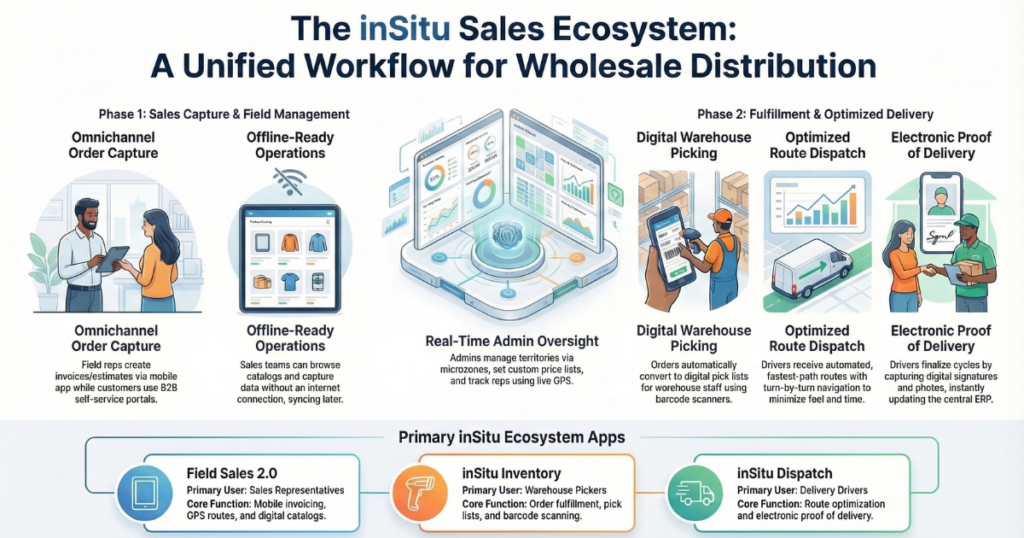
A modern CPG distribution strategy connects:
- Inventory data → to sales forecasting
- Field sales activity → to order management
- Warehouse operations → to delivery execution
- All systems → to centralized analytics
This creates a closed-loop system where every part of the operation informs the next.
The Role of Mobile-First Field Sales Platforms
As distribution becomes more dynamic, mobile-first solutions are increasingly central.
Platforms like inSitu Sales enable distributors to:
- Capture orders in real time from the field
- Track rep activity and performance
- Improve communication between sales, warehouse, and management
- Increase speed and accuracy across the entire sales cycle
This is especially critical for distributors managing large territories or fast-moving SKUs.
Building a Future-Ready Distribution Strategy
To stay competitive in the CPG space, wholesale distributors should focus on:
1. Integration Over Isolation
Disconnected systems create inefficiencies. Prioritize platforms that integrate seamlessly.
2. Real-Time Visibility
Decisions should be based on live data—not yesterday’s reports.
3. Field Enablement
Your reps are your growth engine. Equip them with tools that make them faster and smarter.
4. Scalability
Choose software that can grow with your business—across products, regions, and channels.
Final Thoughts
CPG distribution strategy is no longer just about logistics—it’s about technology-enabled execution. The right software stack doesn’t just support your operations; it defines how effectively you compete.
By investing in the right combination of inventory, sales, analytics, and operational tools, distributors can:
- Increase efficiency
- Drive revenue growth
- Build stronger retail relationships
- Scale with confidence
In a market where speed and visibility are everything, your software is your strategy.